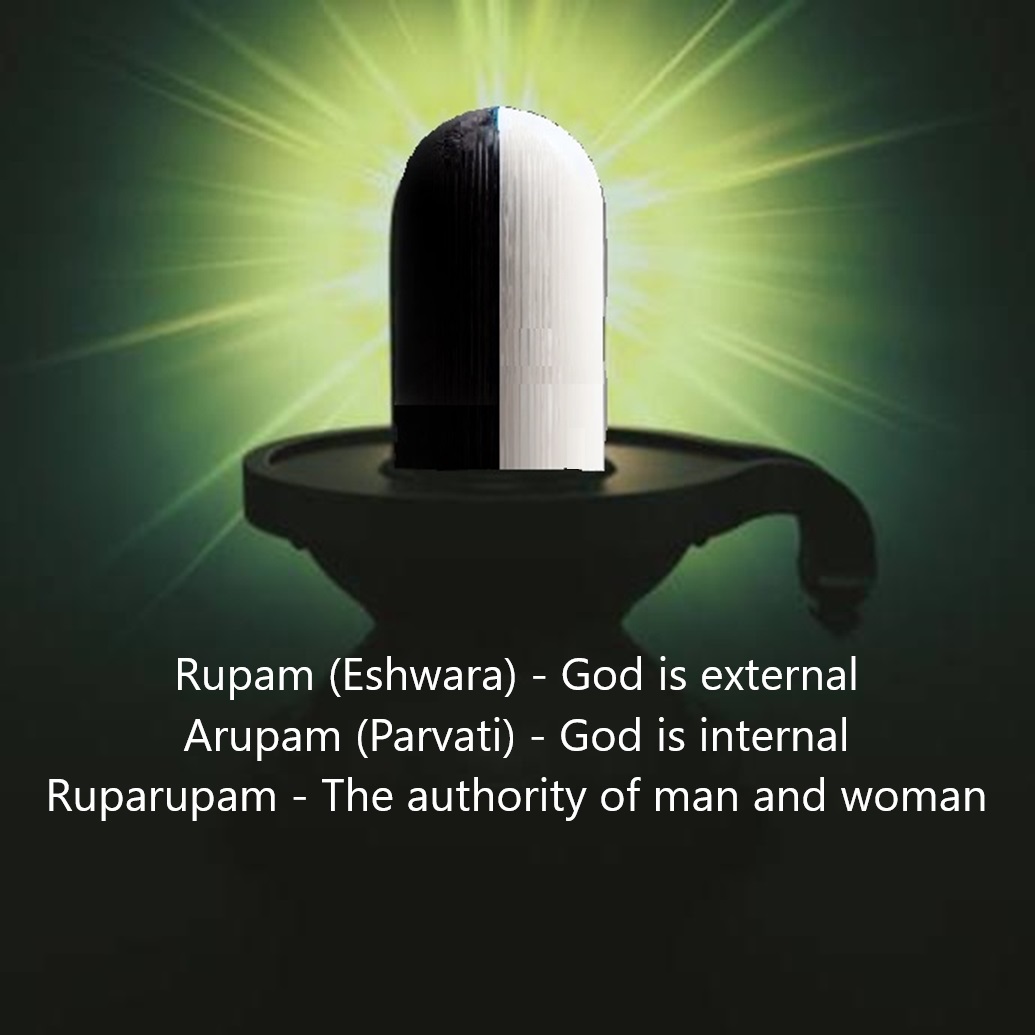
Ruparupam represents the highest form of awareness within the Eshwaram domain — often described as the consciousness of progress itself. It emerges from the togetherness of Eshwara and Parvati, symbolically represented by the lingam made of half-white and half-black stone: a visual embodiment of their inseparable unity. This sacred symbol captures not merely a theological concept but a living philosophical framework that addresses one of the most pressing questions of contemporary life.
The term Ruparupam is a compound of Rupam (the perceivable, the formed, the visible) and Arupam (the non-perceivable, the formless, the invisible). Together, they constitute a synthesis of realities that contribute to better productivity, deeper happiness, sustained progress, elevated consciousness, and ultimately, a better life. Literally translated, Ruparupam means "Ultimate Darisanam" — the complete vision that encompasses both what can be seen and what must be felt.
At its core, Ruparupam addresses a question that has troubled modern societies: Does religion interfere with productivity or scientific progress? Shaivam's response through Ruparupam is neither defensive nor dismissive. Instead, it reframes the question entirely: the responsibility of religion is to satisfy today's and future needs, and Ruparupam provides a framework toward precisely that end. It demonstrates that spirituality and progress are not antagonists but complementary dimensions of a complete human existence.
Ruparupam as a Way of Life: The Complementarity of Living and Progress
Ruparupam articulates a vision of life in which living and progress are not competing priorities but mutually reinforcing realities. The framework challenges the narrow assumption that success requires singular focus on work alone. Instead, it proposes that genuine achievement emerges from a life richly textured with diverse experiences, relationships, and perspectives.
Consider a practical example: when someone takes a vacation and explores different places, they are not merely "taking a break" from productive work. They are acquiring new perspectives through exposure to unfamiliar environments and people. These encounters — with different cultures, landscapes, social dynamics, and ways of thinking — expand the mind's repertoire of understanding. Upon returning to their professional responsibilities, they find themselves equipped with fresh angles from which to approach persistent problems. A challenge that seemed intractable before the journey may suddenly yield to a solution inspired by something observed during travel.
Ruparupam encourages leading a wholesome, balanced life that gives equal importance to family, profession, and social exposures. Exposure, in this context, is not abstract knowledge acquired secondhand but direct encounter with reality in its varied forms. Such exposure cultivates what might be called perspective literacy: the ability to hold multiple viewpoints simultaneously and to draw upon them as circumstances require.
"A life actively engaged across multiple domains — love, work, family, community, recreation, art, sport — produces not distraction but clarity. The mind that encounters variety develops resilience, adaptability, and creative problem-solving capacity."
The Framework of Collective Progress
Progress, in the Ruparupam framework, is not an individual achievement but a collective phenomenon. It happens when everyone in a society pursues individual growth while simultaneously helping others culturally toward their own growth. This is not altruism opposed to self-interest; it is the recognition that individual and collective advancement are inseparable.
Shaivam identifies the present era as Sarva kaandam — "collective progress." This designation is not merely descriptive but prescriptive: it names the form of progress appropriate to our time. Sarva kaandam occurs through collective involvement in both individual and communal life. It requires that people neither retreat into isolated self-development nor dissolve themselves entirely into collective identity. Instead, it calls for a dynamic participation that honours both dimensions.
Ruparupam underscores a thesis of profound contemporary relevance:
- Life contributes to productivity. Vitality and meaning in one's personal life directly amplify professional output.
- Life contributes to scientific progress. Breakthroughs emerge not from relentless specialisation alone but from cross-pollination between fields and the creative leaps that a well-lived life makes possible.
- Life contributes to the better sophistication of humans. A balanced, richly engaged existence cultivates the moral and cognitive maturity that progress depends upon.
Three Pillars of Ruparupam's Enabling Power
Ruparupam's capacity to enable both life and progress rests on three foundational pillars, each addressing a different dimension of human existence.
First Pillar: The Togetherness of Eshwara and Parvati
The union of Eshwara and Parvati embodies a fundamental truth: love is the enabler of life. The framework focuses specifically on the man-woman relationship — on love, commitment, and lifelong partnership — as the primary structure through which human beings access stability, happiness, and the calm necessary for any significant endeavour. Without a consort, life presents greater challenges; the presence of a loving partner elevates existence and makes progress more accessible.
Love provides motivation, emotional support, and a shared framework of meaning. It is not incidental to achievement but foundational to it. The togetherness symbolised by Ruparupam affirms that the most profound human accomplishments emerge not from isolated individuals but from those whose lives are enriched by intimate connection.
Second Pillar: Coordination of Different Perspectives
Ruparupam recognises that within religion itself, there exist isolated viewpoints — perspectives with direct association to religious practice (Rupam) and perspectives without such direct association (Arupam). This duality exposes individuals to two fundamentally different ways of engaging with reality, and this exposure is itself valuable.
Sometimes, life lived with constant direct association to religion can inhibit freedom, curb productivity, and thereby limit growth. Conversely, life lived entirely without reference to spiritual frameworks risks losing depth, meaning, and ethical grounding. Ruparupam is therefore also called "coordination of different perspectives" — an awareness that helps in the better growth of society by preventing the rigidity that comes from singular vision. This awareness grants freedom to explore all aspects of existence without the anxiety that one is betraying either spiritual commitment or worldly responsibility.
Third Pillar: Equal Authority of Man and Woman
Ruparupam is grounded in the philosophical principle of equal authority between man and woman. This is not a concession to contemporary values but an intrinsic feature of the framework's logic. When equality is genuinely embodied — in family life, professional settings, and social participation — it enables the active contribution of all humans toward collective betterment.
A culture rooted in rationality, rather than arbitrary hierarchy, is most suitable for progress, development, productivity, and growth. Ruparupam affirms that progress requires the full participation of humanity, and such participation is possible only when structural equality is maintained.
Rupam: Trusting the External Divine
Rupam represents "life inside the temple" — the domain of perceivable reality, of visible forms, of external divine presence. In the Rupam perspective, humans are understood to rely on and trust in an external God for the welfare of humanity. God is perceived as an all-powerful being, separate from the individual, responsible for protection, guidance, and the maintenance of cosmic and human order.
Bhakti, in this context, is defined as direct belief in and worship of God — trust in divine power to alleviate suffering, ensure progress, and bring about favourable outcomes. Adherents of the Rupam perspective express their faith through religious rituals, temple visits, offerings, prayers, and participation in communal worship. The relationship is one of dependence and trust: humans acknowledge their limitations and turn to the divine for intervention.
The manifestation of Rupam is seen in Eshwara — the perceivable and external embodiment of God. Eshwara represents the divine force that governs the universe, ensuring that human welfare is maintained through divine oversight and active intervention in the world.
Arupam: Initiating Action with Right Intention
Arupam presents a contrasting yet complementary understanding of the divine. It represents "life outside the temple" — the domain of non-perceivable reality, of formless presence, of internal divine manifestation. In the Arupam perspective, individuals are encouraged to begin with right intentions: the welfare of society, the pursuit of love, the commitment to integrity, the expression of passion in daily life.
Human initiative plays the central role in manifesting divine presence. By acting with noble purpose and making meaningful impact, individuals invite God into their lives. Here, God is not something to be actively sought through external rituals but is instead drawn to those who embody righteous intentions and take action to improve the world.
"The key lies in having the right intention. When we approach life with sincerity, honesty, and a genuine desire to do what is morally right, we align ourselves with higher principles and divine wisdom."
Bhakti, in this perspective, is defined as living in accordance with God's message: that humans are responsible for solving their own problems. The divine is not absent but is experienced differently — not as an external authority to be petitioned but as an internal presence to be embodied. "Seeing God," in this sense, is not about witnessing a physical manifestation but experiencing the divine through our actions, choices, and inner state.
The manifestation of Arupam is seen in Parvathi — the divine force that embodies wisdom, nurturing, and empowerment, guiding humans to live in harmony with the world and their responsibilities.
Ruparupam: The Balanced Integration
In the Ruparupam framework, when individuals take initiative with the right intentions — as emphasised in the Arupam perspective — while also maintaining belief in the power and grace of an external God — as emphasised in the Rupam perspective — right things will always happen. This is not magical thinking but a recognition that human effort and divine support operate together, not in opposition.
Ruparupam encourages both active human involvement and trust in divine support. It acknowledges that we are not entirely self-sufficient — that there are forces beyond our control, moments when grace intervenes, circumstances that align in ways we cannot fully explain. At the same time, it insists that we are not passive recipients of fate — that our intentions, choices, and actions matter profoundly and shape the reality we inhabit.
In this perspective, God is understood to be both internal and external, visible and invisible, perceived and felt. Divine power operates both through human actions and through external, supernatural forces. This dual recognition prevents the arrogance of believing we are entirely self-made and the passivity of believing we are entirely dependent.
Ruparupam promotes a dual form of Bhakti: direct belief in God's external form and grace, alongside the internal realisation of God's presence through righteous living. The faithful are encouraged to engage in both traditional forms of worship and religious rituals, while also recognising that living a life of integrity, service, and purpose is equally an act of devotion.
Ruparupam as Applied Dual Monism
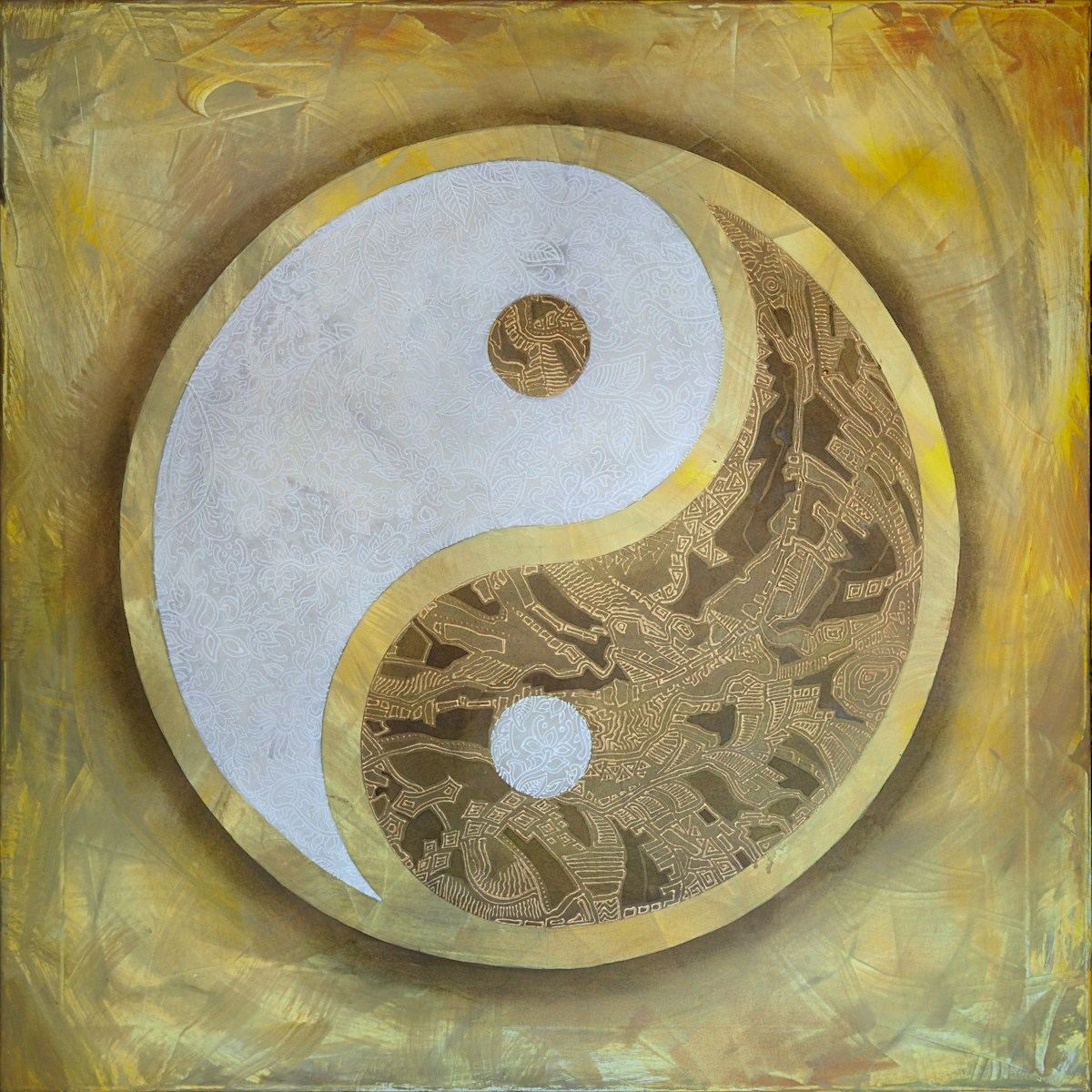
As an expression of Dual Monism, Ruparupam exemplifies Shaivam's fundamental philosophical architecture. It demonstrates how two apparently opposed perspectives can be held together without contradiction — not by collapsing them into a vague middle ground but by recognising them as complementary dimensions of a single reality.
Rupam — The External
Reliance on a visible, external God. Temple worship, ritual, prayer. Stability, continuity with tradition, a sense of being held within a larger cosmic order.
Arupam — The Internal
Human initiative, responsibility, and action. God is internal and invisible, manifesting through human deeds. Personal agency, adaptation, and innovation.
Ruparupam combines both views, suggesting that human initiative and divine grace are equally necessary for progress. This synthesis is not a theoretical construct but a practical framework for living. One can maintain devotion to traditional religious practices while simultaneously embracing the responsibilities of modern life — professional excellence, scientific curiosity, technological innovation, social reform — not as competing loyalties but as complementary expressions of a complete human existence.
Ruparupam thus offers not merely a theological concept but a framework for contemporary spiritual life — one that honours the past while embracing the future, that maintains depth while encouraging breadth, and that recognises the divine in both the temple and the world. This balance is not static but continuously renewed through awareness, intention, and responsible engagement with both dimensions of reality.