A comprehensive guide to the philosophy, principles, and practice
Shaivam is a spiritual philosophy and way of life that emerges from the ancient traditions of South India, particularly rooted in Tamil Nadu's rich philosophical heritage. The word Shaivam derives from 'One family' indicating that all people are of same heriditary without differences
Unlike many religious systems that demand adherence to fixed beliefs, Shaivam is fundamentally concerned with freedom — the freedom of consciousness to grow, explore, and transcend its current limitations. It holds empathy not as a virtue among many, but as the very fabric of enlightened awareness: the recognition that all consciousness is essentially one, even as it manifests in distinct and irreducible forms.
Historically, Shaivam has expressed itself through temple traditions, devotional poetry (particularly the Thevaram and other Shaivite texts), philosophical treatises, and ritual practice. Yet its essence is neither geographically bound nor temporally limited. The insights it offers are as relevant to navigating modern career challenges as they are to understanding the cosmic structure of reality.
What distinguishes Shaivam from other philosophical systems — whether Advaita Vedanta, Dvaita, or Western philosophies — is its insistence on Dual Monism (Undvaitam): the recognition that reality has two irreducible dimensions that are, paradoxically, also one. It refuses the false choice between materialism and spiritualism, individual and collective, change and permanence, transcendence and engagement.
Shaivam invites all sincere seekers, regardless of background, caste, gender, or nationality. It does not demand that you abandon your current beliefs, but rather that you bring a willingness to examine them, refine them, and hold them lightly enough to keep growing.
Undvaitam
At the heart of Shaivam lies a profound recognition: "There are always two realities; they are different, yet they are the same." This is neither pure Advaita (non-dualism) nor strict Dvaita (dualism), but a third understanding that holds both together.
Shaivam describes reality as having two encompassing domains — Viswesam and Eshwaram — that together account for the full spectrum of existence.
| Dimension | Viswesam | Eshwaram |
|---|---|---|
| Nature | Static, ever-encompassing reality | Dynamic, ever-evolving reality |
| Truth Type | Objective truth (Sathyam + Nithyam) | Relative truth, context-sensitive |
| Function | Repository of archetypes and foundational principles | Domain of action, culture, science, ethics |
| Representative | Viswesa — Nataraja of Chidambaram | Various forms of Eshwara and Parvati |
| Core Question | "What is to be believed?" | "How is belief lived, tested, and refined?" |
| Orientation | Foundational, grounding, orienting | Adaptive, progressive, responsive |
The static, encompassing reality that provides the eternal foundation. It contains the archetypes, the foundational truths that do not shift with circumstances. Represented by Viswesa (Nataraja of Chidambaram), it is the cosmic dancer whose dance creates and contains all of existence. Viswesam is what we can rely on absolutely — the ground beneath every step of progress.
The dynamic, living reality where humans engage with the world. Science, ethics, culture, art, relationships — these all belong to Eshwaram, the domain of progressive refinement. Represented by the various forms of Eshwara and Parvati, it is where the principles of Viswesam are applied, tested, and lived. Eshwaram is the laboratory of consciousness.
Shaivam recognises three fundamental ways of engaging with reality — each essential, each incomplete without the others.
The path of alignment with Viswesam — the foundational convictions that orient all action: Sathyam (goodness and truth), Shivam (love and auspiciousness), Nithyam (embrace of change). This path provides the compass without which all action becomes directionless.
The path of active engagement with Eshwaram — inquiry, meaning-seeking, continuous refinement. This is the path of the scientist, the artist, the philosopher: one who does not rest in inherited answers but tests principles against lived experience.
The human condition itself — the living bridge between belief and pursuit. This path is walked by anyone who integrates conviction with action, who becomes the philosophy rather than merely practising it. It is the fullest expression of Shaivam.
Everything needs change (Nithyam) AND everything is just right (Nilayam). This is not contradiction but the very heart of existence — that growth and acceptance are both necessary, and neither cancels the other. Consciousness elevates by holding both.
Reality is unified — perceivable and non-perceivable together. Awareness is acceptance of this reality. Consciousness is continuous awareness: the ongoing process of learning, consolidating, and adapting to an ever-expanding understanding of what is real.
Life is an endless cycle of achievements: Inception (Ganesha) → Execution (Subramaniam) → Unofficial Impact (Parvati) → Official Impact (Shivam) → Renewal (Nandi). No achievement is final; every completion opens a new beginning.
In Shaivam, deities are not mythological characters to be worshipped out of fear or favour. They are philosophical principles that map the full range of human potential and cosmic structure.
The cosmic dancer whose dance is reality itself. Gender-balanced, Viswesa represents the foundational truth that contains both constancy and change — the archetype of archetypes, the source from which all principles emerge.
The abstract form representing that which is beyond current human understanding. Creator of the universe, Eshwara is the destination — truth in its long-range, objective form. The Lingam embodies the unknown that draws us forward.
The human form representing all human faculties and capabilities. Maintainer of the universe, Parvati is the path — how belief is lived and refined moment to moment. As Lalitha, she makes reality visible and teaches us to live fully in the present.
The remover of obstacles — not external obstacles, but the internal limitations of limited vision. Half-human, half-elephant: the elephant head symbolises imagined vision that reaches beyond current experience; the human body, the capacity to act upon it.
The destroyer of internal evil — doubt, fear, and guilt. Subramaniam represents the transformation of personal preference (Valli) through duty and love (Theivaanai), embodying the conversion of selfish desire into purposeful action.
"Na" (no) + "andhi" (end) = That which has no end. Nandi represents the endless nature of existence — endless life, universe, knowledge, and unknowns. The eternal witness who sits before the eternal, teaching us to sit with what we cannot know.
Nine fundamental modes through which consciousness engages with reality. Maturity is shown not by mastering one perspective, but by moving fluidly between all nine as circumstances require.
As Lalitha, Parvati embodies the aspect of reality that is beautiful, alive, and immediately present. She teaches the practice of full engagement with the present moment — seeing the sacred within the ordinary and acting from that recognition.
Nine fundamental modes of consciousness that every mature individual learns to access fluidly
Shaivam maps the universal journey of achievement onto the deity archetypes — a perpetual 5-phase cycle guiding any meaningful endeavour from vision to renewal.
Setting vision, identifying the goal, removing obstacles — beginning with clarity and confident initiative.
Taking focused action, maintaining discipline, overcoming challenges — moving with precision and dedication.
Creating organic influence, nurturing communities, compassionate leadership — the quiet power that transforms.
Achieving recognition, transforming reality, manifestation — when vision becomes legacy.
Integration of learnings, setting a new vision enriched by wisdom gathered — the cycle renews, elevated.
Setting vision, identifying the goal, removing obstacles — beginning with clarity and confident initiative. Ganesha, the remover of obstacles, represents that first essential step of seeing clearly where you want to go and what stands in the way.
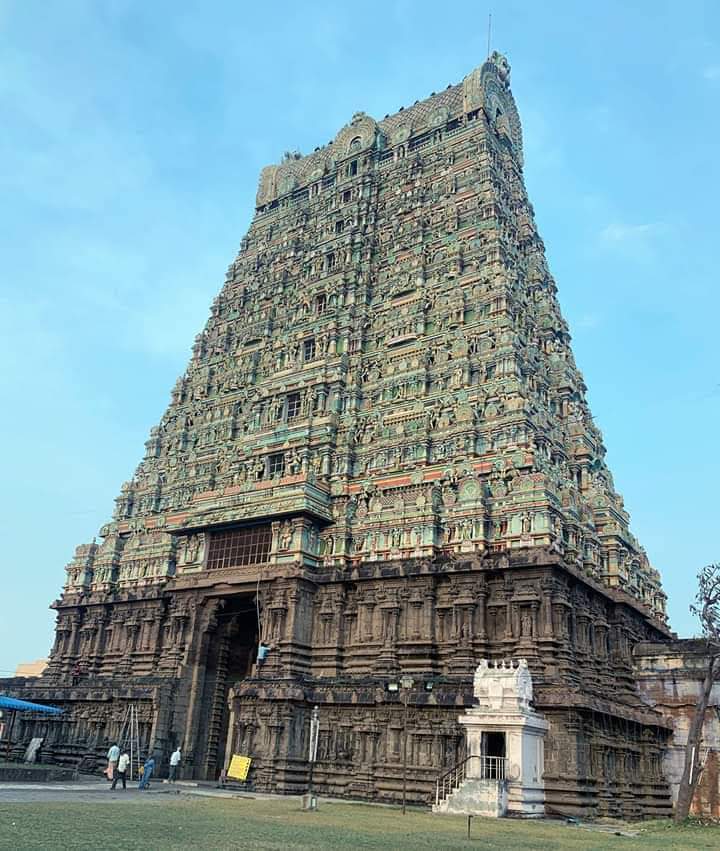
Shaivam is a philosophy that deepens with experience. The most direct way to connect with its living tradition is through the great temples of South India — particularly the Chidambaram Temple, where Viswesa's cosmic dance is eternally performed in stone and devotion.