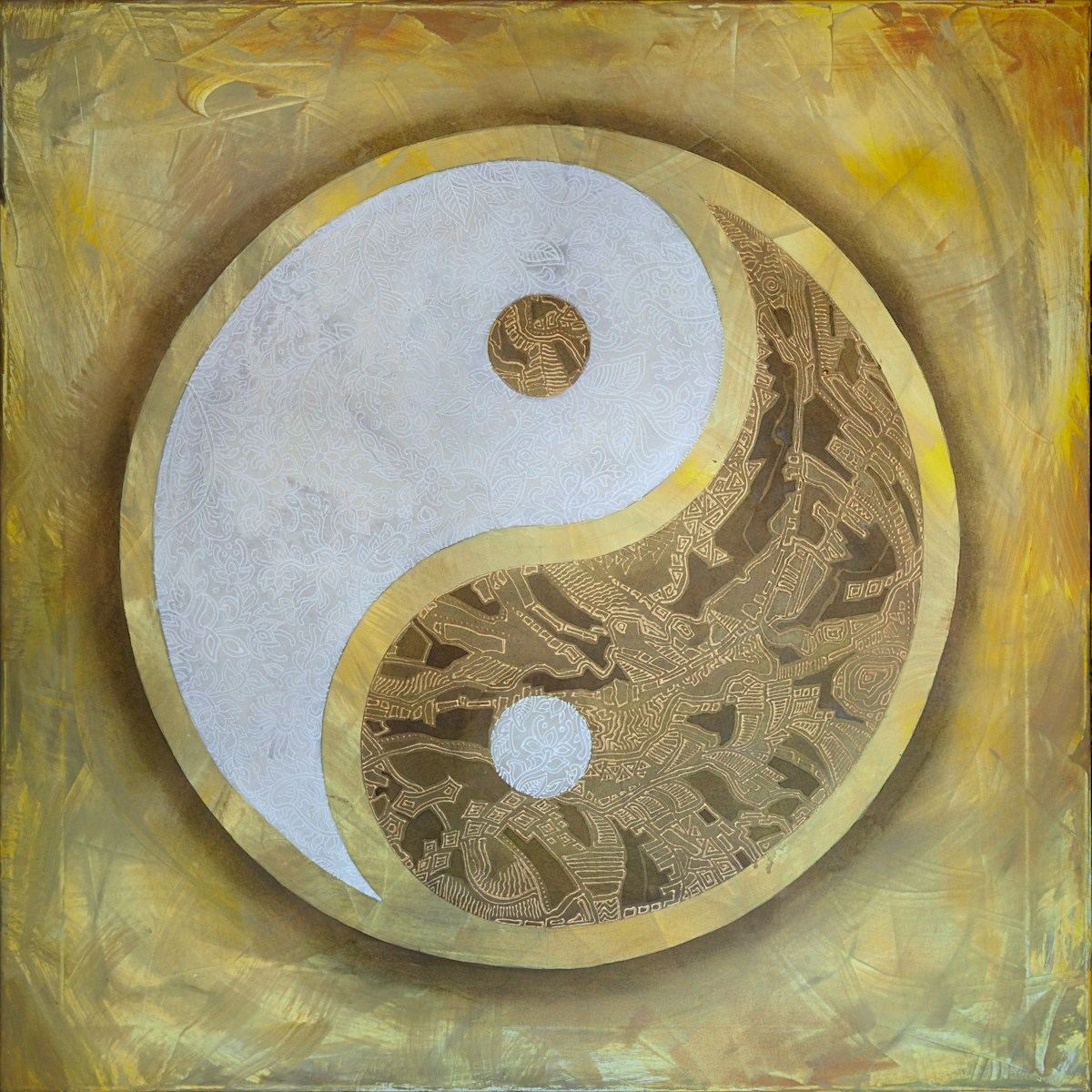
In a world that loves binary thinking — right or wrong, black or white, traditional or progressive — Shaivam philosophy offers a radical and liberating alternative. Its most foundational teaching, Undvaitam (Dual Monism), proposes that reality is not one thing, nor two separate things, but two complementary dimensions of a single whole.
This is not a comfortable idea. Our minds are trained to resolve apparent contradictions, to choose one truth over another. Yet Shaivam insists that the deepest reality is only accessible to those willing to hold two truths simultaneously — not as a logical compromise, but as a direct perception of how things actually are.
What Is Undvaitam?
The word Undvaitam combines the Sanskrit roots "Un" (two) and "Dvaita" (duality), producing a meaning that might be rendered as "the unity-within-duality." It describes reality as having two irreducible aspects that are genuinely different from each other, yet fundamentally united in a way that makes either one incomplete without the other.
This positions Shaivam uniquely in the landscape of Indian philosophy:
- Advaita Vedanta (pure non-dualism) says: ultimately, there is only one reality. All apparent duality is illusion (maya).
- Dvaita (strict dualism) says: there are two genuinely separate realities — the divine and the individual — which can never be identical.
- Undvaitam says: there are genuinely two realities, they are genuinely different, AND they are genuinely the same — not through collapse of difference but through profound complementarity.
"There are always two realities; they are different, yet they are the same."
The Six Key Dual Pairs
Shaivam does not leave Undvaitam as an abstract principle. It identifies six key dual pairs that appear throughout all of reality, from cosmic structure to personal psychology:
1. Viswesam & Eshwaram — Legacy and Modernity
Every system of meaning has a timeless foundation (Viswesam) and a living, evolving expression (Eshwaram). Culture without roots becomes unmoored; tradition without growth becomes a cage. The wisdom is to honour both: the fixed star by which we navigate, and the ship that must adapt to the waters.
2. Sathyam & Nisathyam — Objective and Evolving Truth
There are truths that do not change — the fundamental goodness at the core of existence, the reality of consciousness, the value of love. And there are truths that evolve as our understanding deepens — ethical conclusions, scientific knowledge, social norms. Shaivam holds that both are real: denying objective truth leads to relativism; denying evolving truth leads to dogmatism.
3. Eshwara & Parvati — Destination and Path
Every meaningful life has both a destination (what we are ultimately moving toward) and a path (the actual terrain of each day). Eshwara represents the goal, the ideal, the long-term truth. Parvati represents the path, the immediate action, the human embodiment of divine principle. Neither is complete without the other: a destination without a path is fantasy; a path without a destination is wandering.
4. Rupam & Arupam — Visible and Invisible
Reality has a manifest dimension — the world we can see, touch, measure, and analyse — and an unmanifest dimension — the ground of being from which all form emerges and to which it returns. A purely materialist view, which denies the invisible, misses half of reality. An exclusively spiritual view that denies the visible betrays the sacred nature of the material world.
5. Nithyam & Nilayam — Change and Constancy
Everything changes (Nithyam). And everything is just right as it is (Nilayam). This is perhaps the most personally challenging dual pair: how can I embrace the necessity of growth while also accepting the rightness of the present moment? Shaivam's answer is that both are always true — not alternately, but simultaneously. This is not passivity in the face of change, but a profound peace within it.
6. Sarvam & Nirvaanam — Everything and Nothing
The fullness of manifest existence — everything that is — and the emptiness from which it arises and to which it will return. To cling only to the "everything" produces grasping; to seek only the "nothing" produces detachment that misses the sacredness of existence. Wisdom moves between both with equanimity.
Why This Matters for Daily Life
Dual Monism is not merely a metaphysical position; it is a practical orientation that changes how we live. Consider these common situations through the lens of Undvaitam:
In relationships: We are separate individuals with our own truths (genuine duality) who are also fundamentally one in love and shared humanity (genuine unity). To erase either dimension — demanding sameness or maintaining rigid separation — breaks the relationship. The art of love is holding both.
In career: We need both stability (a foundation of values, skills, and commitments) and adaptability (the willingness to learn, pivot, and grow). The employee who rigidly refuses to change will be left behind; the one who changes constantly never builds anything lasting. The wisdom is in the dual.
In ethics: There are absolute moral truths (harming the innocent is always wrong) and contextual moral questions (how do I best serve this specific situation?) that require evolved understanding. Dual Monism allows us to be both principled and responsive.
Conclusion: The Liberation of Dual Monism
At first encounter, Undvaitam can feel intellectually demanding. We have been trained to choose — to resolve tensions, pick the right answer, and dismiss the other. But what Shaivam offers is more than a new idea: it is a new way of seeing.
When you stop needing to resolve the tension between your ambition and your contentment, your love of tradition and your embrace of change, your individual uniqueness and your deep belonging — something opens. Not confusion, but a clarity that is larger than any single perspective can contain.
This is the freedom that Dual Monism offers: not the freedom from tension, but the freedom within it. The recognition that what appears as contradiction is actually the signature of a reality richer than any of its descriptions.