Imagine looking at a single landscape through nine different windows, each window showing you a genuinely different aspect of the same scene. Stand at one window and you see the trees; at another, the horizon; at a third, the movement of water. None is wrong. All are incomplete alone. Together, they give you something approaching a full picture.
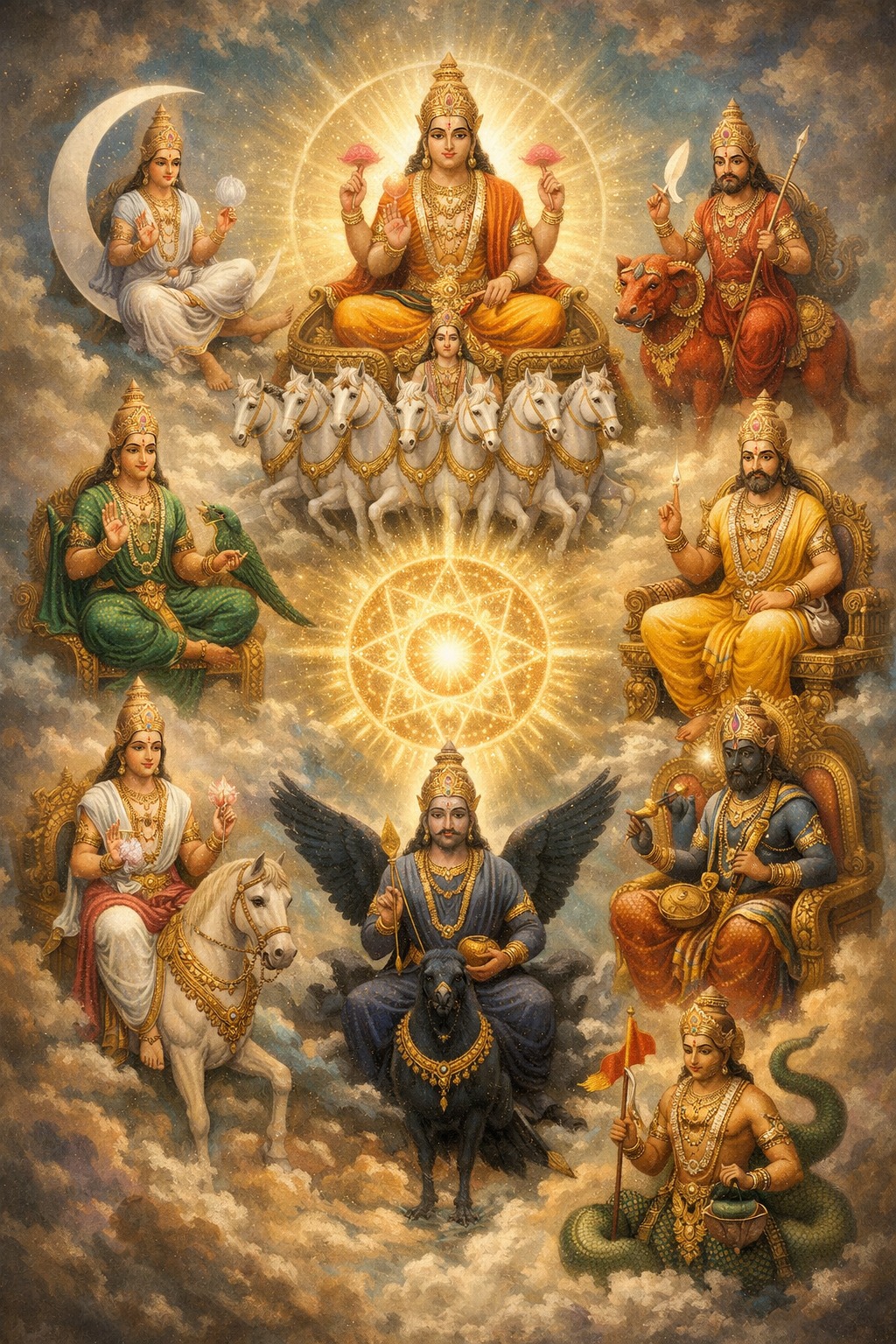
This is the teaching of the Navagraham — the nine fundamental perspectives through which human consciousness engages with reality. In Shaivam philosophy, these are not just astrological concepts but deep maps of how the mind, heart, and will can orient themselves toward experience.
Most of us, for most of our lives, operate primarily from two or three perspectives — the ones we grew up with, the ones our culture reinforces, the ones that feel most natural. The mark of a maturing consciousness, in Shaivam's understanding, is not the mastery of any single perspective but the fluid movement between all nine.
The Nine Perspectives — A Complete Map
Let us explore each of the nine Grahas — not as planets controlling our fate, but as modes of consciousness that we can consciously inhabit:
1. Surya — The Perspective of Identity
The Surya perspective asks: Who am I? It is the mode of self-definition, of clarity about one's essential nature and purpose. When you are operating from Surya, you are concerned with authenticity, with acting in alignment with your core values, with not losing yourself in others' expectations. Surya provides the radiant centre around which all other perspectives orbit. Overdominance: Rigidity, ego-centrism, difficulty receiving feedback.
2. Chandra — The Perspective of Belonging
The Chandra perspective asks: Where do I belong? It is the mode of relational attunement — sensitivity to the emotional field of a situation, awareness of how others feel, the desire for connection and security. When you are operating from Chandra, you read the room, you nurture, you create safety. Overdominance: Over-adaptation, anxiety, difficulty with boundaries.
3. Mangala — The Perspective of Action
The Mangala perspective asks: What needs to be done? It is the mode of decisive, energetic action — the warrior's clarity about what the situation demands. Operating from Mangala, you cut through complexity to the essential action, you act without paralysis, you drive forward. Overdominance: Impulsiveness, aggression, difficulty with nuance or reflection.
4. Budha — The Perspective of Analysis
The Budha perspective asks: How does this work? It is the mode of analytical intelligence — mapping systems, understanding cause and effect, identifying patterns and principles. Operating from Budha, you think clearly and precisely, you communicate accurately, you find the logical structure beneath complexity. Overdominance: Over-intellectualisation, disconnection from feeling and intuition.
5. Guru — The Perspective of Meaning
The Guru perspective asks: Why does this matter? It is the mode of wisdom and meaning-making — the teacher who understands not just facts but significance. Operating from Guru, you discern the deeper purpose behind events, you offer perspective, you help others and yourself find the larger story. Overdominance: Moralism, disconnection from the immediate and practical.
6. Sukra — The Perspective of Value and Beauty
The Sukra perspective asks: What is beautiful and good here? It is the mode of aesthetic and relational intelligence — sensitivity to beauty, pleasure, harmony, and the quality of connection. Operating from Sukra, you create and appreciate beauty, you build genuine rapport, you value what is worth valuing. Overdominance: Hedonism, over-reliance on approval, difficulty with austerity.
7. Shani — The Perspective of Constraint
The Shani perspective asks: What are the real limits here? It is the mode of discipline, responsibility, and honest reckoning with constraint. Operating from Shani, you do not shy away from difficulty, you take the long view, you are willing to delay gratification for lasting results. Overdominance: Excessive severity, difficulty with joy, paralysing caution.
8. Rahu — The Perspective of Disruption
The Rahu perspective asks: What established pattern needs to be challenged? It is the mode of innovation and disruption — the willingness to question what everyone else takes for granted, to see possibility where others see only the status quo. Operating from Rahu, you innovate, you transgress productively, you bring the unexpected. Overdominance: Chronic instability, contrarianism, inability to build.
9. Ketu — The Perspective of Detachment
The Ketu perspective asks: What can I release? It is the mode of transcendence — the capacity to step back from personal investment in outcomes, to see from a spacious impersonal awareness. Operating from Ketu, you are not governed by fear of loss or desire for gain; you act from principle rather than from self-interest. Overdominance: Disengagement, difficulty with commitment and relationship.
"Maturity is not measured by how well you have developed one perspective, but by how freely you can move between all nine."
Self-Assessment: Your Dominant Perspectives
Most people have two or three perspectives they rely on most heavily. This is not a problem — it is natural. The question is whether your dominant perspectives are chosen or simply inherited. And whether your less-developed perspectives are genuinely unavailable to you when the situation calls for them.
Consider a difficult situation you faced recently. Ask:
- Did you primarily ask who am I in this? (Surya) or what do they need? (Chandra)?
- Did you move quickly to action (Mangala) or analysis (Budha)?
- Were you focused on what was right (Guru) or what was beautiful/harmonious (Sukra)?
- Did you look for limits (Shani), opportunities to challenge the norm (Rahu), or ways to step back (Ketu)?
Notice which questions felt natural and which felt foreign. The foreign ones are pointing toward perspectives that deserve development.
Developing Fluidity
Shaivam's practical teaching on the Navagraham is not to become all nine simultaneously — that would be paralysis. It is to develop the capacity to shift — to move from your default perspective to a more appropriate one as the situation demands.
A leader who knows only Mangala (action) will bulldoze when the situation calls for Chandra (relational attunement). A counsellor who knows only Chandra will be unable to offer the clarity of Shani when a client needs honest constraint. A philosopher who knows only Guru will lose people who need the practical precision of Budha.
The practice is simple but demanding: in each significant interaction or decision, consciously ask which perspective the situation calls for — and then deliberately inhabit that perspective, even if it does not come naturally.
Conclusion: The Gift of Nine Perspectives
The Navagraham is not about astrology as commonly understood. It is about the extraordinary range of consciousness available to a human being — nine genuinely different ways of being present, each one a full and legitimate way of engaging with reality.
The gift of Shaivam's teaching here is the invitation to stop being imprisoned in your default perspectives and to become truly fluent in the full language of human awareness. Not to lose your individuality — Surya remains central — but to expand it, deepen it, and make it capable of meeting the full complexity of life.